← Back to all projects SimpleTerminal · Live product · Public feeds
One screen. Five venues. Zero keys.
Read the market without changing tabs.
Market scan, price formation, and leveraged context remain readable in one live workspace.
5Independent exchange feeds
40High-volume markets scanned live
0API keys and backend services
Real product footage · 24 Aug 2026
The footage demonstrates the interface and public market-data pipeline, not trading performance or profit.
What this project proves
AI agents accelerate interface implementation, debugging, and responsive QA; I define the market questions, information hierarchy, data boundaries, and acceptance criteria.
Public live product, five independent exchange feeds, a mobile interface, and a 24-second real product recording.
Evidence trail
Last reviewed2026-08-24See what is live, bounded, and still next.
The product, public market sources, and real operation video are directly inspectable. Values prove the interface and data pipeline, not trading performance or profit.
Publicly usable market terminal
Visitors can open the product, switch markets and timeframes, and inspect charts, book, tape, and derivatives context.
Five independent public market feeds
Binance, OKX, Bybit, Coinbase, and Kraken expose independent connection and stale states with no API key or intermediary backend.
24-second real operation capture
The video preserves the real product, market data, and interaction instead of replacing evidence with an AI-generated interface.
Published analytical limits
Gross spreads exclude fees and slippage, regime uses a limited sample, and the product provides neither execution nor investment advice.
Problem
Market state is fragmented across exchange pages, charts, and depth tools, making it easy to lose the relationship between price, liquidity, and leveraged positioning.
Build
Five independent WebSocket adapters ingest public data, normalise symbols, USD/USDT conversion, and stale states, then compose everything into one stable workspace.
Outcome
A working browser terminal where a Top 40 monitor, chart, cross-venue spreads, order book, tape, and derivatives context stay visible together.
Five public feeds become one readable market workspace
Binance, OKX, Bybit, Coinbase, and Kraken connect independently, so one feed can fail without taking down the workspace.
Symbols and values are normalised, with each venue's own USDT/USD feed correcting USD-quoted markets.
Price, spreads, depth, tape, funding, open interest, and market regime stay in one field of view.
Live product demo
From market scan to venue comparison in 24 seconds
A real product capture showing timeframe switching, chart crosshair, order book, tape, and live quote synchronisation across five venues. The video does not autoplay and the market data is shown for demonstration.
Captured · 2026-08-03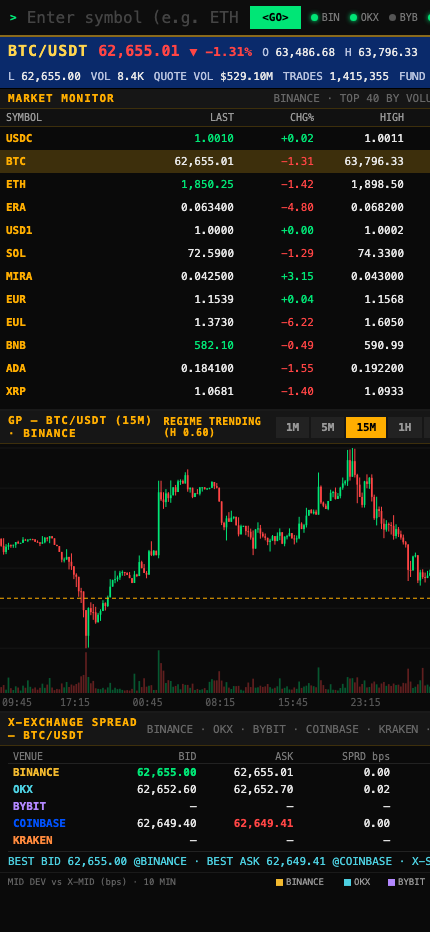
High density without becoming desktop-only
The mobile layout preserves the core scan order: market movement first, price structure second, venue comparison third. Decorative cards stay out of the way so market data keeps the space.
One screen, three layers of market state
SimpleTerminal is designed around three questions: what is moving, how price is being formed, and whether leverage is amplifying the move. The monitor and chart establish context; spread, order book, and tape expose microstructure; funding, open interest, regime, and liquidations add derivatives context without pretending to be a trading signal.
Reliability is visible, not hidden
Every exchange feed owns its reconnect cycle and exposes connected, stale, or unavailable states. History is capped in memory, USD venues are corrected using their own live USDT/USD pair, and stale conversion data is dropped instead of quietly reused.
Deliberately honest boundaries
Cross-exchange spreads are gross and exclude fees and slippage. The regime badge is a coarse reading over a limited candle sample. SimpleTerminal is an observation workspace for comparing evidence, not an execution system or financial advice.