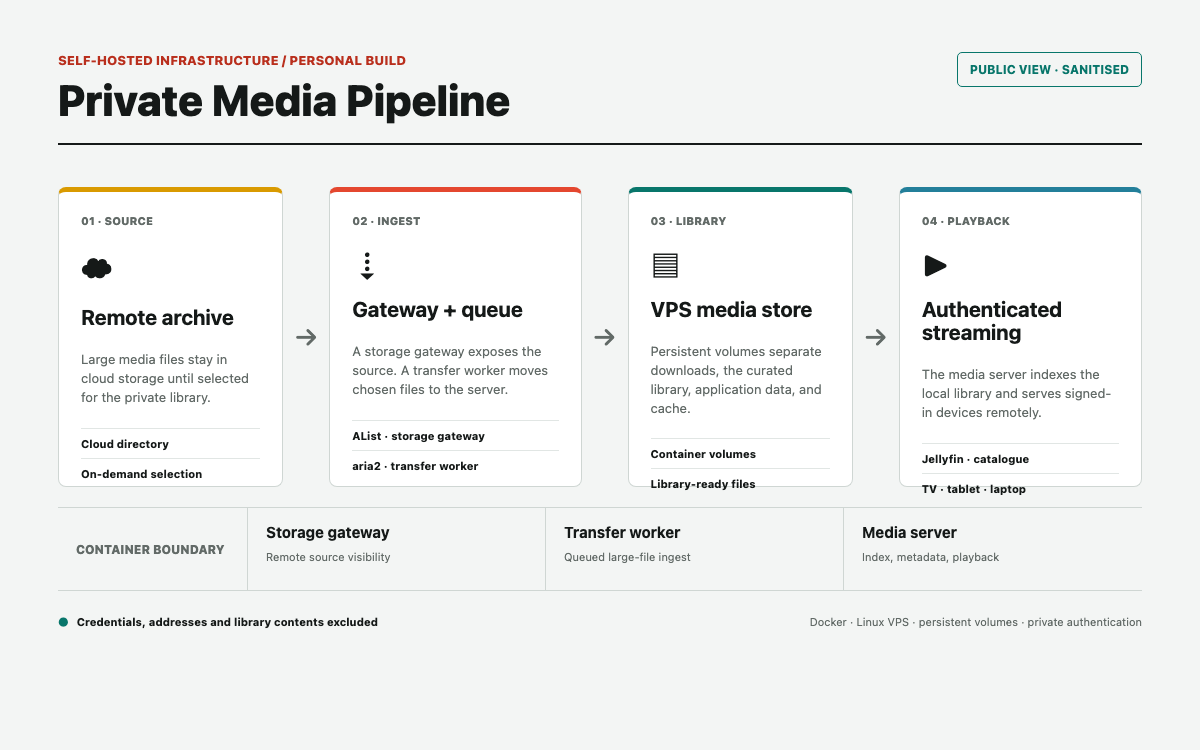
A rebuildable self-hosted pipeline connecting remote cloud files, queued VPS ingest, a persistent media library, and authenticated playback without exposing the private library or server.
Products & toolsDockerSelf-hostingAutomation
2026-07-11
Sanitised four-stage media delivery architecture
3Coordinated Docker services
4Separated delivery stages
0Laptop transfer storage
01
Problem
Large media files lived in remote storage, but the home computer should not become the transfer hub. Source browsing, long-running downloads, the curated library, and remote playback also needed clear boundaries to prevent destructive mistakes and library pollution.
02
Build
Orchestrated AList, aria2, and Jellyfin on a Linux VPS with persistent volumes separating application data, download staging, the curated library, and cache, then documented a repeatable path from cloud selection to verified playback.
03
Outcome
Completed an end-to-end private media workflow that does not depend on laptop storage, validating ingest, curation, indexing, and remote playback with a large media asset. There is deliberately no public demo because the product is protected personal infrastructure, not a public library.
System design
Four stages from remote source to protected playback
01Select
Browse the remote directory through a storage gateway and select only the assets intended for the private library.
02Ingest
A VPS transfer worker handles long-running downloads while staging remains separate from the curated library.
03Curate
Completed files move into the library volume before the media service scans, indexes, and enriches them with metadata.
04Play
Authenticated personal devices connect to the media server without requiring the home computer to stay online or retain a copy.
Why there is no live demo
The working system contains a private media catalogue, authenticated services, and a server address. Publishing any of those would weaken the product rather than prove it. This case study therefore shows the architecture, operating boundaries, and validated flow while excluding credentials, addresses, filenames, and library contents.
The hard part was ownership boundaries
A remote cloud view, a download staging area, and a local media library can look similar in a file browser while having very different deletion and persistence semantics. The build became safer once each mount had one explicit role and the runbook explained what could be cleaned, moved, or rebuilt.
Security work before wider use
The personal deployment is functional, but a production-grade extension should put administration behind a private network or tunnel, enforce HTTPS, minimise exposed ports, rotate secrets, and add storage and service-health monitoring.
Continue the conversation
From evidence to a useful next step.
See where this way of working fits, what I can contribute, and the boundaries I keep around responsible delivery.