Nerdy.im — Anti-Tool-Overload Product Concept
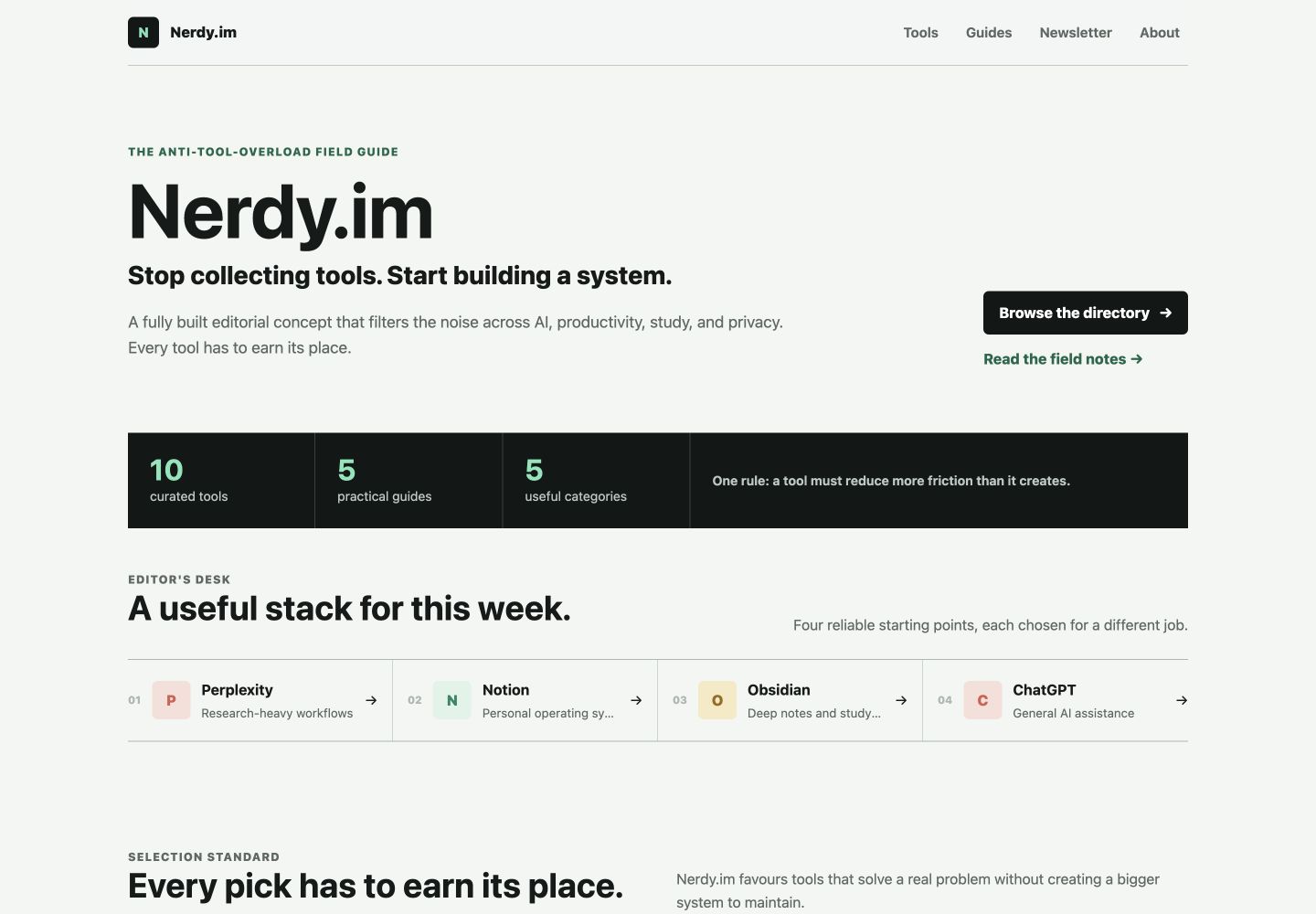
A fully deployed editorial prototype built around one proposition: stop collecting tools and start building a system.
What this project proves
Codex supports the audit, interface implementation, dependency migration, copy editing, and responsive QA; I own the proposition, selection rules, publishing boundaries, and quality judgement.
A deployed 22-route product surface, responsive interface, security configuration, and working subscription entry; no claim of real customers or revenue.
10Sample tool records
5Sample guides and categories
0Known dependency vulnerabilities
Problem
Without real business data, a content-site demo can become little more than a polished layout. It needed a memorable point of view strong enough to drive every product decision.
Build
Defined the anti-tool-overload position, "Stop collecting tools. Start building a system," then implemented structured tool data, guides, a Buttondown integration, SEO, security, and responsive UI in Next.js 16.
Outcome
An honestly labelled concept demo with a complete product surface: 10 sample tools, 5 sample guides, 5 categories, and 22 pre-rendered routes.
From one point of view to a complete product concept
Tools are organised by the real job, pricing model, and setup cost instead of popularity alone.
The directory and short guides explain use cases, limitations, and fit before the reader leaves the site.
A working Buttondown entry point demonstrates how the concept could support retention without claiming an existing active audience.
Product loop
From proposition to directory and editorial guides
A muted walkthrough of the real public site: move from the homepage proposition into the tool directory, filter to AI, then enter the guide library. It demonstrates a coherent 22-route product surface, not customers, revenue, or market traction.
Captured · 2026-08-23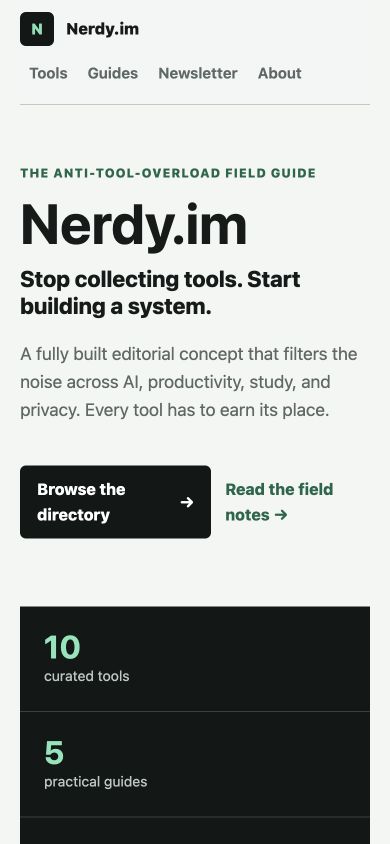
Mobile is not a shrunken desktop page
At 390px, navigation, positioning, both actions, and content counts stay in the first reading sequence. Buttons and long copy wrap naturally without horizontal scrolling.
A demo still needs a sharp proposition
Nerdy.im is not presented as an established business. It is a fully built product concept demonstrating how a strong proposition can shape copy, information architecture, selection rules, visual identity, and the path from discovery to newsletter subscription.
Static does not have to feel unfinished
Tool and guide data remain in typed source files, so the site needs no CMS or database while the catalogue is small. Shared cards, category colour tokens, pre-rendered routes, security headers, sitemap, robots, and a generated social image make the static system feel deliberate rather than temporary.
AI-assisted, but product judgement stays human
Codex accelerated the audit, implementation, dependency migration, copy pass, and responsive QA. The important decisions still required human judgement: what not to claim, which business notes should stay private, and what evidence makes a recommendation credible.