Little Spark Bilingual Learning Game
No account. No ads. Just tap, try and grow across twelve bilingual language, number, and logic activities.
What this project proves
AI agents support activity implementation, debugging, content preparation, and cross-device QA; I own the learning hypotheses, child-privacy boundaries, interaction trade-offs, and observation findings.
Twelve public playable bilingual activities, device-only progress, and one formative child observation; the evidence informs interaction direction, not validated curriculum or educational outcomes.
12Playable learning activities
2Instant languages
0Accounts or remote data collection
Problem
A learning game for ages three to four cannot rely on long copy, complex menus, or account flows. Wrong answers also need to encourage another attempt rather than merely report failure.
Build
Built three learning zones and twelve activities with vanilla HTML, CSS, and JavaScript, plus bilingual copy, browser speech, sound feedback, grown-up settings, and device-only progress.
Outcome
A complete browser-playable prototype with no login, ads, analytics, or remote data API. One-child formative observation also identified real imagery, pursuit, and spoken naming as stronger engagement signals than lower difficulty alone.
From free choice to a supported practice loop
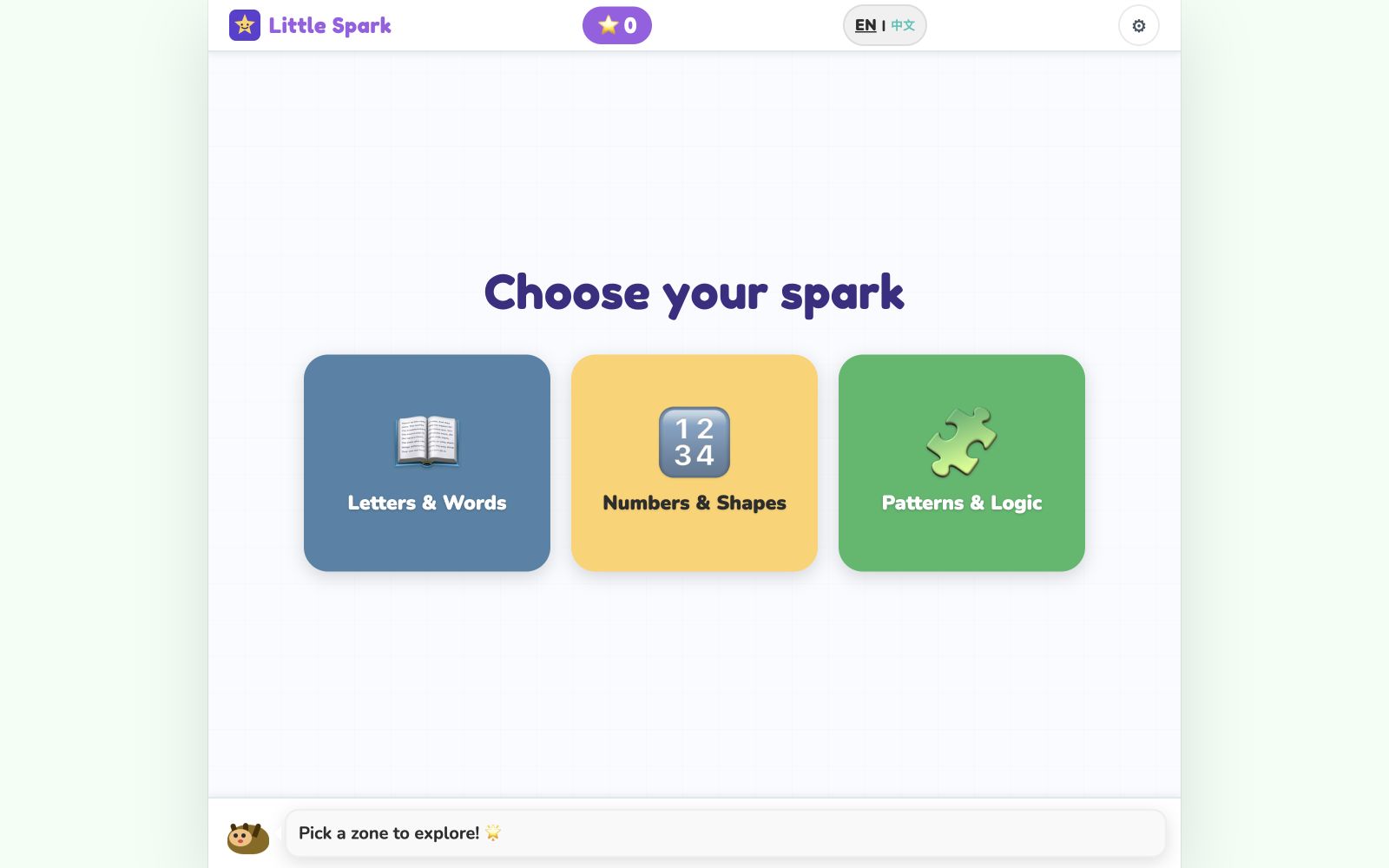
Children choose between three clear worlds without passing through login or setup flows.
Each short task uses large touch targets, pictures, speech, and sound as cues.
Wrong answers trigger encouragement first, followed by progressive hints or option reduction.
Stars and completion badges stay in the current browser, making progress visible without a child account.
Product loop
From learning worlds into one bilingual letter loop
A muted capture of the real public mobile product: choose Letters & Words, enter Letter Explorer, move through illustrated cards, then switch the interface language. The loop shows one path inside a product spanning three learning worlds and twelve activities.
Captured · 2026-08-23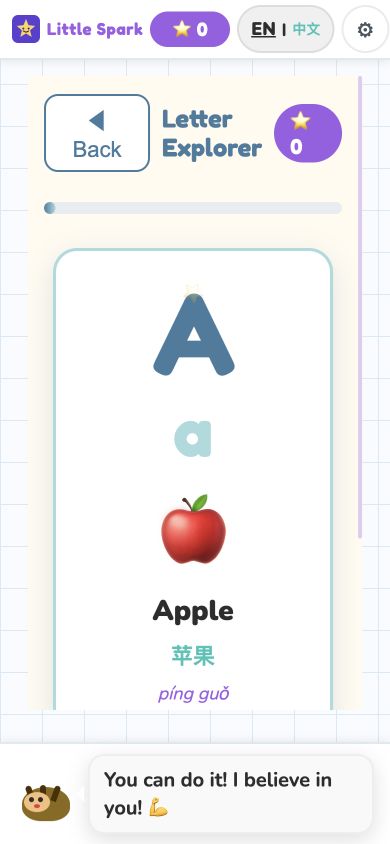
One focus, supported by image, speech, and large touch targets
The mobile activity centres the current letter and image while English, Chinese, and pinyin remain in one learning context without controls overlapping the content.
Privacy by absence
Little Spark has no child profile, login, advertising, analytics, or remote application API. Stars, settings, and completion badges remain in localStorage on the current device.
Encouragement is part of the interaction model
A wrong answer triggers a neutral sound and a retry prompt. Repeated attempts progressively reduce choices or reveal a stronger hint, preserving agency before the game helps complete the task.
Prototype, not a validated curriculum
One-child formative observation found longer voluntary play with a harder pursuit prototype using recognisable photos and spoken naming. This shaped the next interaction hypothesis, but it is not evidence of educational outcomes or broad usability.